Advertising never slows; it rearranges itself around technology, culture, and money. This year, the moves are subtle but decisive: AI and privacy tug in opposite directions, creators and platforms rewrite who owns attention, and immersive tech promises new canvases. Read on for an actionable look at what advertisers should prioritize to get results in 2026.
- The shifting landscape: why 2026 feels different
- AI-first creative: speed with control
- Practical steps for AI-driven creative
- Privacy-first targeting: building an identity strategy
- Checklist for privacy-ready targeting
- Attention economics: quality over impressions
- Short-form video and social commerce: conversion at the point of discovery
- Tactical recipe for social commerce success
- Creator economy and the rise of micro and nano influencers
- Immersive formats: AR, VR, and spatial advertising
- When to invest in immersive ads
- Connected TV and the new video stack
- Audio and in-car: the underrated channels
- Sustainability and values-driven marketing
- Measurement and analytics: unify before you multiply
- Automation, but with guardrails
- Budgeting for 2026: a practical allocation framework
- Organizational changes: teams and workflows that perform
- Real-world examples and lessons learned
- Risk management and brand safety
- Roadmap: a 12-month plan to prepare for 2026
- What to watch in the next 24 months
The shifting landscape: why 2026 feels different
First, a quick reality check. Cookies are mostly background noise now, regulation is tighter, and consumers expect relevance without surveillance. Those conditions change how media is bought and how creative is made.
Second, attention is fragmenting across short-form video, audio, and connected TV, while measurement remains uneven. Brands that adapt measurement frameworks and creative formats will win more efficiently than those chasing last year’s metrics.
Finally, creativity and automation are no longer opposites. Generative AI speeds production but forces new standards for authenticity and brand safety. The winners will be teams that marshal both speed and human judgment.
AI-first creative: speed with control
Generative tools are transforming creative production from a slow, expensive process into an iterative, on-demand workflow. You can now produce dozens of personalized ad variants in the time it used to take to draft one storyboard.
That speed is intoxicating, but quality matters. Treat AI as a creative assistant rather than an autopilot: use it to generate concepts and drafts, then apply human oversight for tone, cultural nuance, and brand alignment.
In practice, successful teams build guardrails — style guides, prompt libraries, and approval workflows — so generated assets remain on-brand. I’ve seen an e-commerce client cut time-to-market by 70% while keeping conversions steady by adopting this hybrid model.
Practical steps for AI-driven creative
Start by documenting brand voice and taboo topics; these become your prompt constraints. Next, set up a rapid test-and-learn loop where small audiences validate variants before scale.
Finally, allocate a small budget for creative testing each month rather than a single pre-season push. Continuous iteration beats episodic perfection in attention-driven channels like short-form video.
Privacy-first targeting: building an identity strategy
The era of third-party cookies is fading and identity solutions are multiplying — from clean-room partnerships to authenticated logins and publisher-first IDs. Brands must pick a pragmatic mix that balances reach, precision, and compliance.
Don’t chase a single universal ID as if it’s a silver bullet. Instead, diversify: invest in first-party data capture, partnerships with data-clean rooms, and contextual targeting to reach audiences without invasive tracking.
Audience modeling and cohort-based approaches will become table stakes. They allow for relevant messaging while reducing legal and reputational risk tied to individual-level tracking.
Checklist for privacy-ready targeting
- Audit what first-party data you already own and where consent sits.
- Set up consented logins or loyalty programs to capture reliable identifiers.
- Evaluate publisher ID solutions and clean-room partners for critical segments.
- Invest in contextual engines and creative that performs without cookies.
Attention economics: quality over impressions
Metrics that equate success to views or clicks alone are losing currency. Advertisers increasingly care about attention quality — how long someone engaged, whether they watched creatively relevant segments, and whether an ad prompted meaningful action.
New attention metrics combine dwell time, viewability, and interaction signals. Use them to re-weight media buys and to prize formats that create durable memory rather than transient reach.
Publishers and platforms that can show attention-based lift will command premium CPMs. Smart advertisers will reallocate spend toward fewer, higher-quality impressions when those impressions demonstrably move outcomes.
Short-form video and social commerce: conversion at the point of discovery
Short-form video is now a discovery engine and a sales funnel all at once. Platforms have integrated shopping features that let consumers move from inspiration to checkout in a matter of taps.
For brands, the implication is straightforward: make creative that captures attention in the first two seconds, leverages native behaviors like duet or remix, and closes with a simple path to purchase.
I’ve worked with brands that turned micro-influencer collaborations into direct revenue streams by shipping daily creative aligned to platform trends. The revenue-per-impression can be small, but the volume and velocity add up.
Tactical recipe for social commerce success
- Use trend-aware briefs to keep creative fresh and platform-native.
- Test multiple CTAs and purchase flows; prefer single-click or one-step add-to-cart experiences.
- Blend organic creator content with paid amplification to keep authenticity high.
Creator economy and the rise of micro and nano influencers
Macro-celebrity deals remain valuable for broad awareness, but micro and nano influencers offer better engagement per dollar and deeper niche credibility. Their audiences often trust recommendations more than polished celebrity endorsements.
Scale is achieved not by one big influencer but by systems that manage dozens or hundreds of smaller partnerships. That means tooling for outreach, content rights management, and payments.
One small DTC client I advised moved 40% of its influencer budget to smaller creators and saw a 30% improvement in ROAS because those creators matched the brand’s niche communities more closely.
Immersive formats: AR, VR, and spatial advertising

Immersive advertising is no longer science fiction. Augmented reality filters, try-on tools, and VR brand spaces let consumers test products and experience stories in ways static ads cannot replicate.
These formats are effective for consideration and trial — think virtual try-ons for eyewear or furniture placed into a living room via AR. They’re less about immediate scale and more about reducing friction in the purchase decision.
Brands should prioritize immersive experiences for categories where physical trial matters, and design low-friction entry points that gracefully exit into the commerce flow.
When to invest in immersive ads
- High-consideration categories: furniture, beauty, eyewear.
- Products that benefit from visual or spatial proof.
- Campaigns that aim to build an experiential halo, not just immediate clicks.
Connected TV and the new video stack
Connected TV (CTV) growth continues as streaming consumption displaces linear TV. CTV offers scale and a lean-back viewing context where storytelling can thrive, but measurement still lags behind digital standards.
Expect more programmatic buying in CTV with better identity linkage to household-level outcomes. That will enable smoother cross-platform attribution and more efficient investment decisions.
Advertisers should mix brand storytelling on CTV with short-form activation elsewhere, using unified measurement to understand how TV shifts search and conversion behavior.
Audio and in-car: the underrated channels
Audio continues to grow through podcasts, streaming music, and smart speakers. Its strength is intimacy and multitasking-friendly formats that allow ads to be heard while people commute or work.
In-car advertising is emerging with connected vehicles, offering location-aware, context-rich opportunities. These channels require creative built for voice and ambient listening rather than visual spectacle.
Test simple, conversational scripts and leverage host-read authenticity or contextually relevant ad insertion to maximize recall and action.
Sustainability and values-driven marketing
Consumers expect transparency and environmental responsibility. Marketing that ignores sustainability language risks looking tone-deaf; those that demonstrate concrete commitments earn share of trust.
But green claims must be verifiable. Brands should use clear, measurable commitments and avoid vague promises that invite scrutiny. Authentic storytelling about supply chains, materials, or community impact performs better than abstract virtue signaling.
In my campaigns, messaging tied to specific, measurable sustainability milestones produced higher consideration scores than generic eco-claims.
Measurement and analytics: unify before you multiply
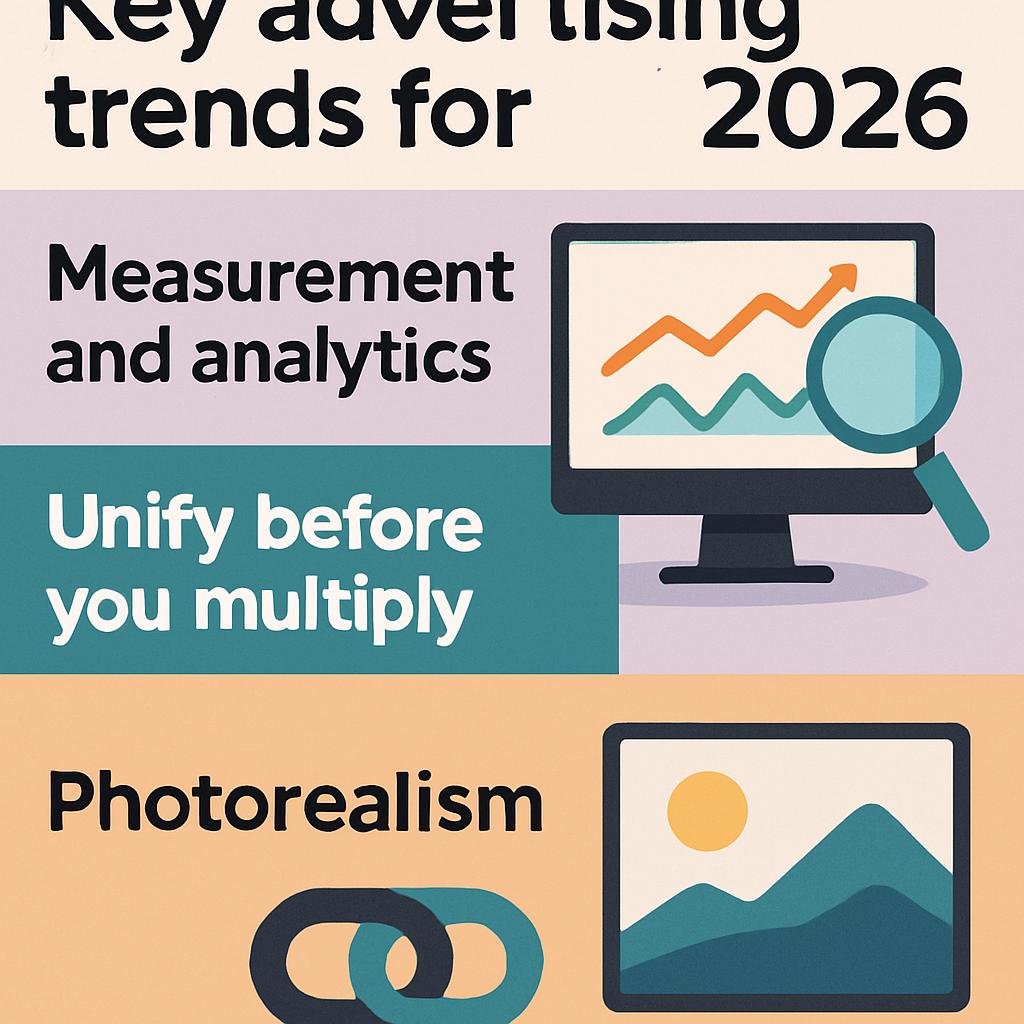
2026 demands a measurement strategy that connects upper-funnel brand work with lower-funnel performance. That means investing in data infrastructure, attribution models that handle multi-touch journeys, and cross-device identity strategies.
Clean-room analytics and first-party data integration will become central to proving incremental lift from media mix changes. Don’t expect a single metric to tell the whole story; build a composite view that includes attention, lift, and conversion signals.
Start with two priorities: make sure your dashboards align to business outcomes, and invest in experiments that can isolate causal impact rather than relying purely on correlation.
Automation, but with guardrails
Automated bidding, creative optimization, and dynamic personalization are table stakes. But automation without oversight can drift into irrelevant or risky placements, damaging brand equity.
Define clear rules for automated systems: blocked content categories, audience exclusions, and minimum creative quality thresholds. Combine automated optimization with periodic manual audits to catch edge cases.
Automation should free your team to focus on strategy and creative testing, not replace those disciplines entirely.
Budgeting for 2026: a practical allocation framework
There isn’t a one-size-fits-all budget, but a practical framework helps prioritize. Split budgets into: foundation (data, identity, measurement), experimentation (new formats, creators), and scale (proven channels and media buys).
For many brands a sensible starting mix might be 20% foundation, 30% experimentation, and 50% scale. Adjust based on lifecycle stage: early-stage brands invest more in discovery, incumbents focus on efficiency and retention.
The key is to keep a rolling experiment fund so you can capitalize on trends without disrupting the performance engine.
| Budget bucket | Suggested allocation | Primary focus |
|---|---|---|
| Foundation | 20% | Data, identity, measurement infrastructure |
| Experimentation | 30% | AI creative, immersive formats, creators |
| Scale | 50% | Channels with proven ROAS and broad reach |
Organizational changes: teams and workflows that perform
Teams that thrive in 2026 mix specialists and generalists. You need data scientists to interpret model outputs, creative leads who understand platforms, and producers who move fast with AI tools.
Cross-functional squads — combining media, creative, analytics, and legal — reduce friction and speed decision-making. Daily or weekly syncs that focus on learnings rather than status updates keep experimentation aligned to outcomes.
Invest in tooling for asset management and rights clearance to handle the volume of content generated across creators and platforms.
Real-world examples and lessons learned
One retail brand I worked with prioritized first-party data collection through a loyalty program and matched that to programmatic CTV buys. The result was improved attribution and a tighter correlation between TV spend and online sales uplift.
Another example: a beauty startup used micro-influencers plus rapid AI-enabled creative tests to iterate on messaging, which reduced CAC by optimizing the variant that resonated most with a niche audience segment.
These examples underline a few themes: test quickly, favor real relationships over blunt reach, and make data infrastructure a foundation rather than an afterthought.
Risk management and brand safety
With more automated and programmatic placements, brand safety must be proactive. Define unacceptable content categories, maintain a blacklist of risky publishers, and use third-party verification when necessary.
Also plan for creative risks posed by generative AI, including deepfake misuse or generated content that inadvertently infringes IP. Clear usage rights, human review, and legal oversight are essential safeguards.
Maintaining a steady, transparent risk review process prevents costly brand incidents and preserves long-term trust.
Roadmap: a 12-month plan to prepare for 2026
Month 1–3: Audit data assets, privacy compliance, and creative production capacity. Establish a prompt and approval library for AI outputs.
Month 4–6: Run small experiments across social commerce, CTV, and creator partnerships. Start integrating clean-room partners and test contextual targeting engines.
Month 7–12: Scale winning experiments, refine measurement with unified dashboards, and formalize cross-functional teams for continuous optimization.
What to watch in the next 24 months
Keep an eye on regulator responses to generative content, advances in identity interoperability, and improvements in attention measurement standards. Each of these will reshape how ad dollars flow.
Also watch platform product roadmaps: newly introduced shopping features, ad formats, and creator monetization tools can create fresh opportunities for brand performance.
Finally, consumer sentiment around privacy and brand values will continue to influence media effectiveness, so survey your audiences regularly rather than assuming stability.
The advertising landscape in 2026 rewards adaptability more than perfect prediction. Balance investment across infrastructure, creative experimentation, and channel scale. Keep human judgment central while using automation to accelerate learning.
Approach the year with a test-and-scale mindset: run disciplined experiments, measure with rigor, and make incremental reallocations toward tactics that prove both short-term performance and long-term brand value.
For more practical guides, case studies, and templates to help you implement these shifts, visit https://news-ads.com/ and explore our other materials.