Every few years the landscape of data storage and processing shifts enough that a new reading list becomes necessary. Whether you’re designing OLTP systems, tuning analytical warehouses, or orchestrating event streams, choosing the right books will save months of trial and error. This guide collects enduring classics, solid modern introductions, and focused titles that are still relevant for Database books worth reading in 2026 without overwhelming you with every publication out there.
- Why read books about databases in an age of blogs and docs?
- How I pick and test the books I recommend
- Foundational classics that still teach
- Designing Data-Intensive Applications — Martin Kleppmann
- Database System Concepts — Abraham Silberschatz, Henry F. Korth, S. Sudarshan
- Transaction Processing: Concepts and Techniques — Jim Gray and Andreas Reuter
- The Art of SQL — Stephane Faroult with Peter Robson
- Modern and focused titles you should read
- NoSQL Distilled — Pramod J. Sadalage and Martin Fowler
- Seven Databases in Seven Weeks — Eric Redmond and Jim R. Wilson
- Streaming Systems — Tyler Akidau, Slava Chernyak, and Reuven Lax
- SQL Performance Explained — Markus Winand
- Specialized books for serious problems
- Principles of Distributed Database Systems — M. Tamer Özsu and Patrick Valduriez
- High Performance MySQL — Baron Schwartz, Peter Zaitsev, and Vadim Tkachenko
- Mastering PostgreSQL in Application Development — Dimitri Fontaine
- Data Modeling Made Simple — Steve Hoberman
- Practical study strategies for getting the most out of these books
- Quick picks by use case
- Balancing reading with hands-on learning
- Keeping the list fresh: new topics to watch in 2026
- Recommended reading order depending on your role
- Where to combine books with other resources
Why read books about databases in an age of blogs and docs?
Documentation and blog posts are excellent for quick answers, but books let you hold an entire system of thought in one place. They map concepts, trade-offs, and historical context, which helps you reason about unfamiliar problems instead of just copying solutions.
Books also provide curated sequences of ideas; a chaptered exposition can reveal why a design choice exists, what alternatives were considered, and how the field arrived at current practice. That perspective matters when you must make architectural decisions under uncertainty.
How I pick and test the books I recommend
I read with a project in mind and take notes in a single notebook for every title, so I can compare approaches later. Over the past decade I’ve rebuilt small production systems using patterns learned from books: migrating a legacy MySQL schema to a normalized, index-aware design and creating streaming ETL with a combination of ideas from database texts and practical streaming guides.
When I recommend a book, I check that its core lessons still apply to modern engines and that it offers clear examples or exercises I can follow. That criterion weeds out well-written histories that are interesting but not actionable for engineers shipping code.
Foundational classics that still teach
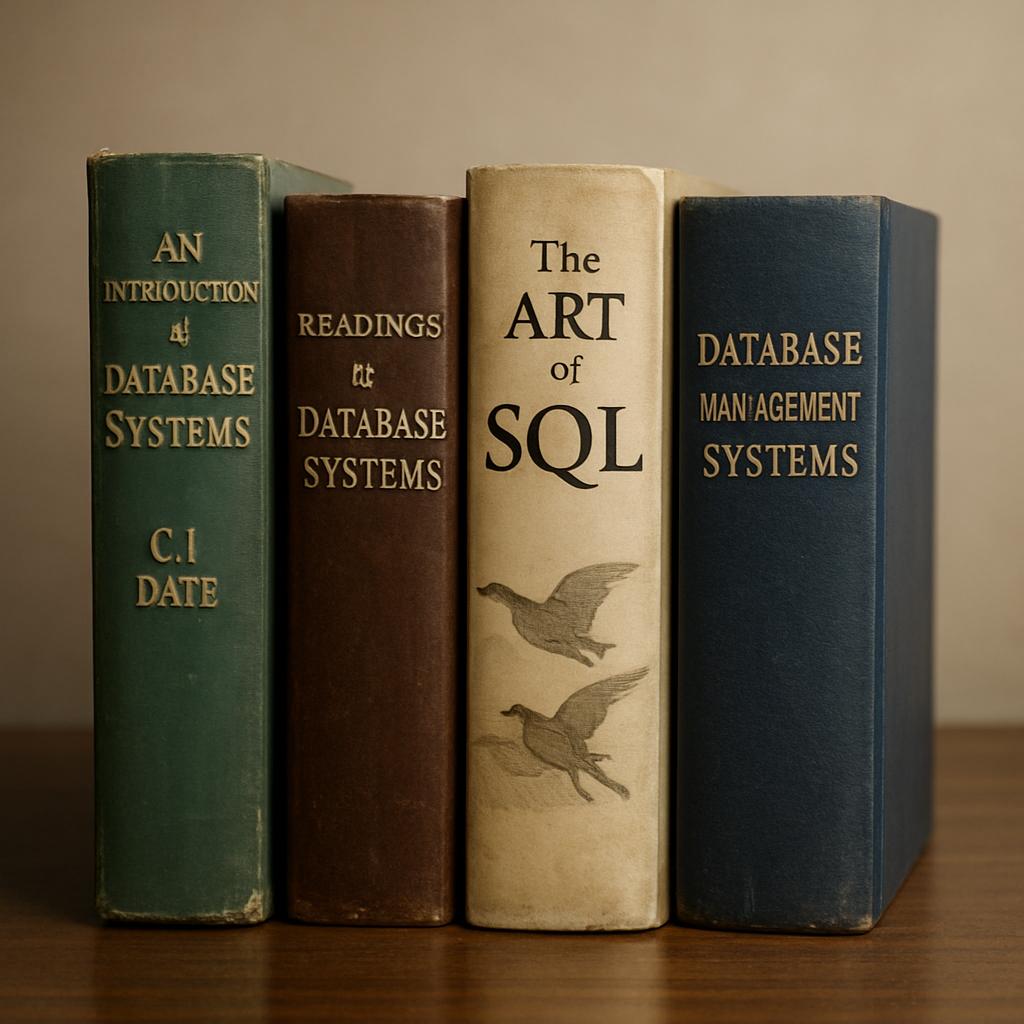
These books are worth owning because they teach the enduring principles behind how databases work and the trade-offs you’ll face running them in production. Read them slowly and work through examples where possible.
Designing Data-Intensive Applications — Martin Kleppmann
Kleppmann’s book synthesizes storage engines, distributed systems, and data processing into a readable narrative. It balances theory and practical concerns, explaining replication, partitioning, consistency models, and stream processing in a way that helps you choose architectures rather than follow recipes.
When I was designing a resilient event-processing pipeline, the book’s discussion of log-structured storage and change-data-capture patterns guided our choice to decouple ingestion from processing using durable append-only logs. That architecture noticeably simplified retries and auditing.
Database System Concepts — Abraham Silberschatz, Henry F. Korth, S. Sudarshan
This textbook remains a clear exposition of query processing, transaction management, and database internals. It’s a good reference for engineers who need to refresh fundamentals like locking, indexing, and query optimization without wading through research papers.
I recommend using it as a companion when you read engine documentation; it helps translate implementation details into concepts you can reason about when diagnosing performance problems or understanding how recovery works.
Transaction Processing: Concepts and Techniques — Jim Gray and Andreas Reuter
Gray and Reuter’s treatment of transactions and fault tolerance is deep and practical. The book lays out durability, atomicity, isolation, and recovery with concrete algorithms and failure models that remain relevant in distributed databases and transactional systems.
Even if some examples predate modern cloud services, the principles of designing for atomicity under failure, and the trade-offs between synchronous and asynchronous replication, are directly applicable to any transactional design you’ll encounter in 2026.
The Art of SQL — Stephane Faroult with Peter Robson
This book treats SQL as a craft rather than a checklist of commands, showing how to write clear, maintainable, and efficient queries. It’s full of practical patterns for rethinking queries so they play to the strengths of the optimizer.
For teams that still treat ORM-generated SQL as inevitable, this book is a corrective: small rewrites can dramatically reduce execution time and resource usage, and the book gives a mental toolkit for doing that work effectively.
Modern and focused titles you should read
After mastering fundamentals, practical guides and modern takes help you solve specific problems: scaling reads, designing schemas, choosing a storage model, or building event-driven pipelines. These books bridge theory and practice.
NoSQL Distilled — Pramod J. Sadalage and Martin Fowler
This short, pragmatic book explains when NoSQL is appropriate and how to weigh consistency, modeling, and operational concerns across different NoSQL families. It’s especially helpful for avoiding the “use NoSQL because it sounds modern” mistake.
When advising teams, I’ve seen this book shorten conversations: it gives clear questions to ask about latency, scaling patterns, and query shapes before committing to a document or key-value store.
Seven Databases in Seven Weeks — Eric Redmond and Jim R. Wilson
Not a deep dive into any single system, this book gives a hands-on tour of different storage philosophies: relational, document, columnar, graph, and more. It’s a great way to expose yourself to alternative models and their idiomatic APIs.
Pairing short projects from the book with small prototype applications is an efficient way to decide whether a particular database paradigm fits your product’s workload and query patterns.
Streaming Systems — Tyler Akidau, Slava Chernyak, and Reuven Lax
Streaming has grown from niche to mainstream, and this book explains event-time semantics, watermarking, windowing, and fault-tolerant processing in readable terms. It’s practical for engineers building real-time analytics or continuous pipelines.
When we rebuilt a near-real-time analytics dashboard, the book’s emphasis on event-time correctness helped avoid subtle bugs that would have produced inconsistent windows across out-of-order events.
SQL Performance Explained — Markus Winand
Winand’s book demystifies how modern SQL engines execute queries and where indexes help or hinder. It focuses on portable principles rather than engine-specific knobs, so the lessons transfer across MySQL, PostgreSQL, SQL Server, and cloud data warehouses.
I recommend developers keep a copy on their desk when tackling slow queries; it’s a quick guide to diagnosis and better indexing strategies without requiring deep internals knowledge.
Specialized books for serious problems
When projects encounter scale or complexity that simple rules can’t solve, specialized texts provide depth. These books are not beginner-friendly but repay the effort when you’re responsible for production at high scale.
Principles of Distributed Database Systems — M. Tamer Özsu and Patrick Valduriez
This book dives into distributed algorithms, fragmentation, distributed query processing, and consistency in a systematic way. It’s particularly useful for architects designing geo-distributed systems or custom sharding strategies.
Use it to understand how distribution affects latency and how to partition data to reduce cross-node joins and global coordination. The formal treatment helps you weigh CAP-style trade-offs with more nuance.
High Performance MySQL — Baron Schwartz, Peter Zaitsev, and Vadim Tkachenko
Focused on MySQL and its derivatives, this title covers schema design, indexing, replication, and tuning for production. Even if you use another RDBMS, the operational practices and troubleshooting patterns translate well.
In one project I inherited a noisy, lagging replica set; the diagnostic checklist in this book helped identify index contention and improper query plans that we fixed within days.
Mastering PostgreSQL in Application Development — Dimitri Fontaine
Fontaine’s work shows how to use PostgreSQL beyond being a passive data store—from leveraging stored procedures to using JSONB and powerful indexing features. It’s practical for teams that want to reduce ORM impedance and exploit PostgreSQL’s feature set.
The book guided our migration from forcing relational models onto inherently hierarchical data; using JSONB for certain subsystems simplified development and cut query complexity.
Data Modeling Made Simple — Steve Hoberman
Good data models are the foundation of maintainable systems, and Hoberman provides clear, repeatable techniques for translating business rules into normalized, extensible schemas. The book is practical for analysts and engineers who share schema design responsibilities.
When teams skip modeling, technical debt accumulates in the form of workarounds and brittle queries. Investing a few days with this book early in a project prevents months of schema surgery later.
Practical study strategies for getting the most out of these books
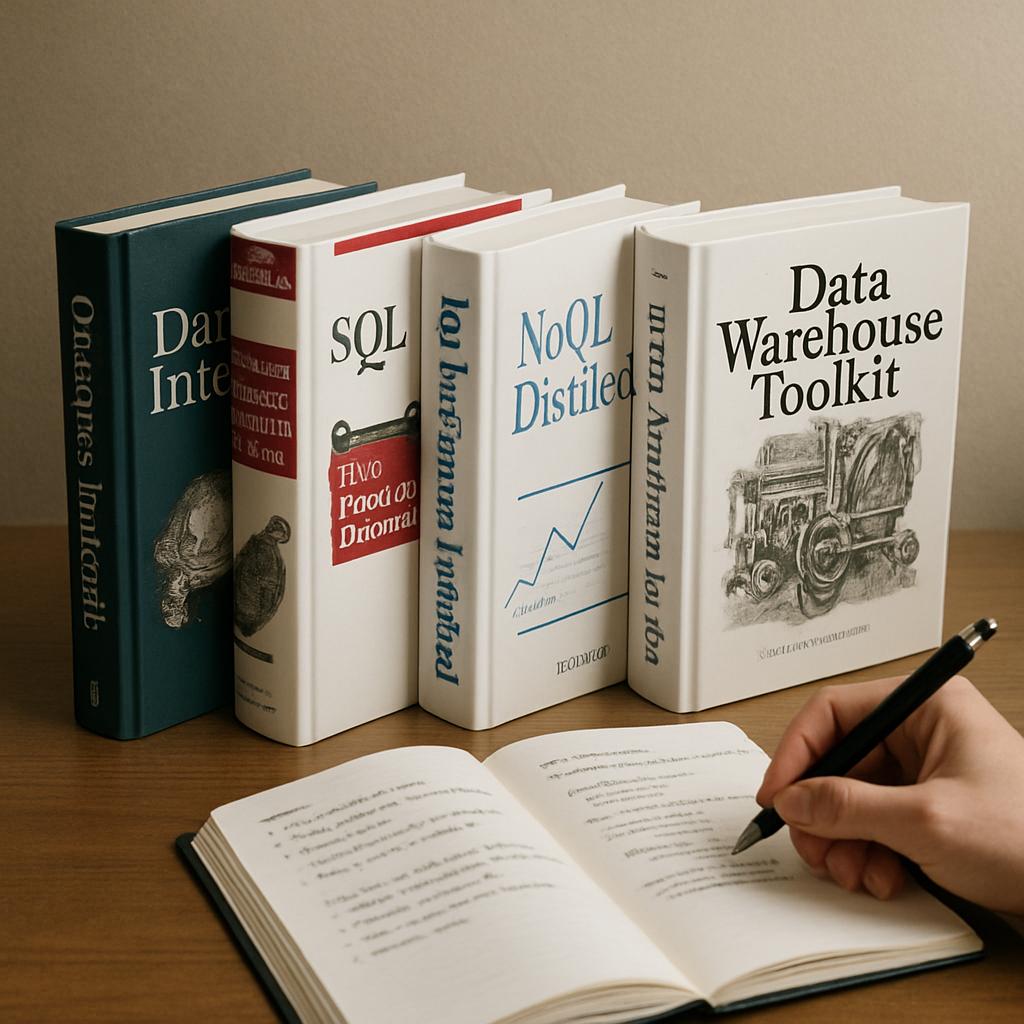
Reading books passively is a missed opportunity. Treat each book as a course: take notes, implement small projects, and create a checklist of patterns and anti-patterns to apply immediately. This approach converts abstract concepts into muscle memory.
Alternate between theory and practice. Read a chapter about query optimization, then apply the techniques to a slow query in your codebase or a small sample dataset. This immediate feedback loop cements learning and reveals where the theory meets messy reality.
Quick picks by use case
Below is a compact table for quick reference: whether you’re tuning queries, building streaming systems, or picking a NoSQL approach, these picks will get you started without reading everything at once.
| Use case | Top pick | Why |
|---|---|---|
| Architecting fault-tolerant systems | Designing Data-Intensive Applications | Comprehensive treatment of distribution patterns and storage choices |
| Streaming and event processing | Streaming Systems | Practical patterns for event-time and windowed computation |
| NoSQL evaluation | NoSQL Distilled | Short guide to trade-offs across NoSQL families |
| SQL performance | SQL Performance Explained | Portable advice on indexing and query patterns |
| Data modeling | Data Modeling Made Simple | Actionable techniques for structure and evolution |
Balancing reading with hands-on learning
A book can’t substitute direct experience, and direct experience can mislead without theoretical context. Alternate focused reading with short, time-boxed experiments: prototype a sharded design in a sandbox, run ingest benchmarks, or simulate failure scenarios.
Use the books as design artifacts. For example, when evaluating replication strategies, consult the treatment in a foundational text, then test the approach at a small scale to observe behavior under churn and network partitions.
Keeping the list fresh: new topics to watch in 2026
As of 2026, cloud-native databases, serverless operational models, and hybrid transactional/analytical processing scenarios continue to evolve. Books that help you reason about elastic scaling, cost trade-offs, and observability will be especially valuable.
Also watch for titles that tie database design to regulatory and privacy concerns; as data governance becomes operationally central, books bridging engineering and compliance are increasingly useful for architects and managers.
Recommended reading order depending on your role
If you’re an engineer just starting out with databases, begin with a clear conceptual textbook and a practical SQL performance guide. If you’re an architect, prioritize distributed systems and design-oriented titles. If you’re a data engineer moving into streaming work, pair Streaming Systems with Designing Data-Intensive Applications for complementary viewpoints.
For managers and technical leads, skim the foundational books to understand trade-offs and read case-study oriented chapters closely so you can evaluate team proposals and timelines with context.
Where to combine books with other resources
Books form a backbone; blogs, conference talks, and open-source documentation fill in version-specific details and tooling changes. After reading a book chapter on replication, read a vendor’s documentation and look for community posts about real-world troubleshooting to round out your understanding.
Courses and workshops that include labs are especially valuable when a book introduces nontrivial operational practices like setting up consensus protocols or tuning a distributed query planner. Use them to move from theory to confident execution.
Choosing what to read is a pragmatic act: pick books that match the systems you run and the problems you expect to solve next. The titles above have helped me both design robust systems and avoid costly mistakes in production, and they should repay the time you invest in them.
If you enjoyed this guide and want more curated technical reading lists and practical articles, visit https://news-ads.com/ and explore other materials on our website. Happy reading—and happy building.